
This project is archived and no longer maintained.
RATb
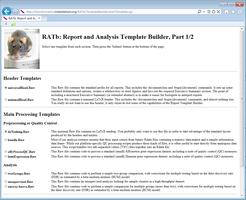
| Overview | |
|---|---|
| Description | The Report and Analysis Template Builder (RATb) uses XML and R to create reusable, structured Sweave files for the statistical and bioinformatic analysis of high-throughput ‘omics’ datasets. |
| Development Information | |
| URL | http://bioinformatics.mdanderson.org/RATb/TemplateBuilder/startTemplate.cgi (opens in new tab) |
| Current version | 2.1 |
| Last updated | 2009-03-12 |
| Help and Support | |
| Contact | MDACC-Bioinfo-IT-Admin@mdanderson.org |
RATb : The Report and Analysis Template Builder
The Report and Analysis Template Builder (RATb) uses XML and R to create reusable, structured Sweave files for the statistical and bioinformatic analysis of high-throughput ‘omics’ datasets.
Documentation
Using RATb
Use RATb: http://bioinformatics.mdanderson.org/RATb/TemplateBuilder/startTemplate.cgi.
A Template XML Document Type Description (DTD) file
<?xml version="1.0"?>
<!ELEMENT Templates    (Template+)>
<!ELEMENT Template     (FileName,Description,Parameters)>
  <!ATTLIST Template Type (header|trailer|qc|analysis) #REQUIRED>
<!ELEMENT FileName     (#PCDATA)>
<!ELEMENT Description  (#PCDATA)>
<!ELEMENT Parameters   (Item*)>
<!ELEMENT Item         (#PCDATA)>
   <!ATTLIST Item Name    CDATA #REQUIRED>
   <!ATTLIST Item Default CDATA "">
   <!ATTLIST Item Long    (yes|no) "no">
A Sample XML Template File
<?xml version="1.0"?>

<Template Type="header">
  <FileName>Templates/minimalHead.Rnw</FileName>
  <Description>This Rnw file contains a minimal LaTeX header. This includes the
       \documentclass and \begin{document} commands,and almost nothing else.
       You really do not want to use this header; it only exists to test some
       of the capabilities of the Report Template Builder.
  </Description>
  <Parameters>
    <Item Name="TITLE">The title of the report.</Item>
    <Item Name="AUTHOR">The author(s) of the report.</Item>
    <Item Name="DATE">The date the report was prepared.</Item>
  </Parameters>
</Template>
A Sample Sweave (Rnw) Template Component file
%%%%%%%%%%%%%%%%%%%%%%%%%%%%%%%%%%%%%%%%%%%%%%%%%%%%%%%%%%%%%%
% The definitive version of this file lives in a subversion
% repository at
% $URL: http://dqsbcb03/svn/krc-perlcgi-server-software-01/trunk/RATb/RATb/minimalHead.Rnw $.
% The most recent version was produced by $Author: krcoombes $
% on $Date: 2009-03-05 14:28:53 -0600 (Thu, 05 Mar 2009) $.
%%%%%%%%%%%%%%%%%%%%%%%%%%%%%%%%%%%%%%%%%%%%%%%%%%%%%%%%%%%%%%

\documentclass{article}
\title{TITLE}
\author{AUTHOR}
\date{DATE}

\begin{document}
\maketitle
Auxuliary material
Some templates refer to auxiliary data or information; those are stored at ./Auxiliary.
Notes
The XML component is used to describe the replacable parameters in a template file; the data in these files drives the construction of the RATb web site. The XML DTD file is really quite simple.
It defines the ‘Templates’ document type to be a list of one or more ‘Template’ objects. Each ‘Template’ consists of:
- A ‘FileName’, which is the location of the actual source of the template,
- A ‘Description’, which is a short paragraph explaining the purpose of the template
- A set of ‘Parameters’.
In turn, the ‘Parameters’ form a list of ‘Item’ objects. The ‘Name’ of an ‘Item’ is the name of the parameter in the template file. The contents of an ‘Item’ describes the semantics/interpretation of that parameter. Optionally, a parameter ‘Item’ can have a ‘Default’ value, and a yes/no indicator of whether it is ‘Long’ (and so needs an entire text area in a form) or not (and so can fit into a smaller text field).
The actual template files are prepared as Sweave files. Sweave is a tool that combines the R statistical programming environment with the LaTeX typesetting system. This combination provides a powerful tool for conducting reproducible research.
Template files should be categorized (in the ‘Type’ attribute of the XML ‘Template’ entry) as one of four types: ‘header’, ‘trailer’, ‘qc’, or ‘analysis’. (In our templates, preprocessing steps are included under ‘qc’.) The types are used to organize the layout on the web site. A complete filled-in template file consists of one header, one processor that is either ‘qc’ or ‘analysis’, and one ‘trailer’. Thus, most of the actual analysis templates are constructed without LaTex preambles or \begin{document} or \end{document} commands.